What is MND?
Motor neurone disease (MND) is a progressive neurological condition that damages the nerves responsible for controlling muscle movement. It causes increasing muscle weakness and can affect mobility, speech, swallowing and breathing. There is no cure for MND, and its symptoms and progression vary considerably between individuals.
According to the MND Association, more than 5,000 adults in the UK are living with the condition at any one time. Although massage for motor neurone disease cannot treat the condition or slow its progression, many find that gentle, caring touch can have a significant positive effect on physical relaxation and emotional wellbeing. Massage belongs alongside, rather than in place of, medical care, however its contribution to comfort and wellbeing can still be meaningful.
The MND Association discusses complementary therapies for MND, including massage, as possible sources of relaxation and wellbeing that can work alongside conventional treatment, and for me, that's the heart of this work. Before beginning massage, it's important that clients check with their healthcare team that the treatment is appropriate for their individual circumstances.
How I got into massage for MND
In the summer I often volunteer at Glastonbury Festival, in the accessibility campsite near the Pyramid Stage. It’s brilliantly set up, with wheelchairs available to hire, shuttle buses, volunteers to help people get around, and a big marquee where a team of us offer free massage, Reiki, energy work and other treatments. This introduced me to working with a variety of conditions, and my first experience specifically with MND came later, through a support group in Saltford where I was invited to offer head, neck and shoulder massages. In the last four years I’ve started working with the MND Association and supporting people living with MND, and it’s been a really wonderful and eye-opening experience. Seeing their resilience, openness, and support for one another is incredible, and these days I work with several people with MND regularly. For some, it has meant weekly sessions; for others, once every few months.
Adapting massage for MND
Everyone experiences MND differently, so for first sessions, I always take time to do a thorough consultation.
For me this involves a lot of listening. We’ll talk through medical history, mobility, areas of pain, and any practical considerations around positioning. We’ll talk about things like numbness or tingling, and any areas they want to avoid. I check in again each time we meet, because needs can change.
Some clients are able to visit my treatment room, which has stairs, where we might work on a particular area if they're comfortable using the massage couch. Others are more comfortable receiving massage at home, in a chair or hospital bed. There’s also often a lot of emotional and mental wellbeing support, especially for those in the earlier stages of their MND journey, and I try to be a steady presence in that space. We might work through clothing or focus only on the hands or head, without oils.
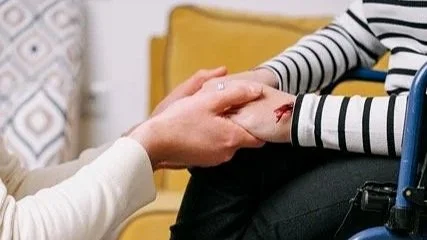
I begin with a few quiet moments and gentle grounding techniques to help the client relax. I might rest my hands gently on their shoulders or arms, or guide them through noticing the support of the chair, the texture of a blanket or the sounds around them. Sometimes just holding someone’s hand with care and sitting quietly can be what they need most. A lot of clients live such busy lives, between medical appointments, care visits, phone calls, and keeping track of many moving parts, a few minutes of calm and stillness can be really powerful.
We'll usually talk a little at the beginning. Some might share how their week has been or what's on their mind. I always make room for those conversations, but I also try to create a space when they don't have to explain anything at all.
Areas affected by muscle wasting can be tender, and it’s usually a fine balance of being soft where needed and strong where it helps. Above all, this is person-led work. Massage for people with MND is not about following a set sequence, but helping someone feel comfortable, respected and in control of their experience.
For people living with MND, so much physical contact can be connected to practical tasks: getting dressed, being moved, attending medical appointments or receiving personal care. Massage can offer a different kind of touch, where nothing needs to be accomplished beyond comfort and rest. More grounding at the end of the session too, brings them back gradually by noticing the sounds around them, feeling their body again, and coming back into the space.
So much of holistic massage is about non-verbal communication. It’s picking up on the small cues like a slightly deeper breath, a bit of muscle tension, or even just a change in the tone of someone’s voice. I don’t think about it too much anymore, it’s quite intuitive now, but those subtle signals really guide the session. Open communication is also key. I always want clients to feel that they can ask me anything during the session.
The impact of working with MND
My clients are amazing, and this work has taught me so much about gratitude and resilience. Four years ago, I didn’t know whether I’d be any help in the MND world, and now I feel like I am. I feel resilient too, because some days are hard, but I’m so glad to be a part of it. I’ve also learned that I need to be mindful of how much I take on. Some weeks, I’ll only book a certain number of MND clients. Not because I don’t want to see more, but because the work can be more physically demanding. Treating someone in a hospital bed, for example, is very different from a standard couch treatment. There’s more leaning, more adapting, and I have to protect my own body so that I can keep doing the work I love.
I think it’s just as important for carers too. I've met lots of them, and they so often say, ‘Oh no, I’d rather my partner had the massage’ which I completely understand, but they need it too. It’s easy to think, ‘Well, they’re going through something harder than me,’ but that doesn’t mean you don’t also deserve rest, care, and support. Having that downtime, however it looks for you, is so important.
Lately, I’ve been thinking a lot about the importance of this kind of work, and I truly believe it’s so needed. I’d love to see more holistic therapists reaching out to support the MND community and people living with other long-term or life-limiting conditions. The work is incredibly rewarding.
How to get started
If you're living with MND and considering massage, it's worth knowing that the MND Association offers a Wellbeing Support Fund. Eligible people, as well as unpaid carers and family members, may be able to receive a contribution towards complementary therapies for MND, including massage. I've worked with several clients whose treatments were supported by external funding, so it's worth exploring what help might be available.
If you or someone close to you has MND, please get in touch. Throughout the year I have different capacity for mobile treatments but you are welcome to send me message and I can let you know my availability. We can talk through your needs and see whether massage might be a comfortable and supportive option.
Get in touch with me to open a conversation about how holistic massage can benefit someone with MND.
